
Most organisations cannot say how many people work for them. The reason is structural rather than careless, and it defeats workforce planning, access governance and every headcount conversation with finance.
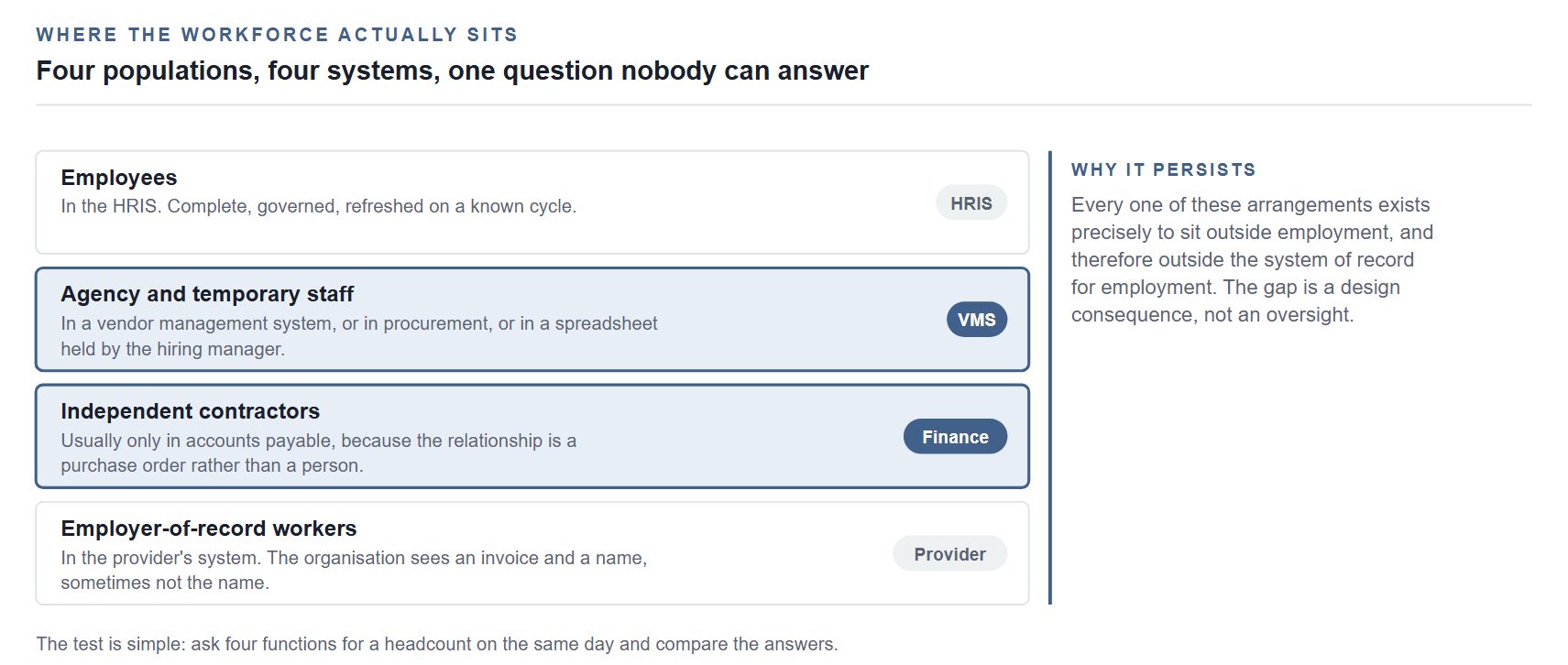
Each layer is recorded somewhere. The problem is that no single system holds all four, and no single function is accountable for the total.
Ask most organisations how many people work for them and you will get a confident number. Ask the same question of HR, finance, IT and procurement on the same day and you will usually get four different ones.
This is not a data quality problem in the usual sense. Nobody has been careless. It is a structural consequence of how non-employment work is arranged, and it defeats several things organisations are currently trying to do.
Why the gap exists by design
An HRIS is a system of record for employment. Contractors, agency workers and employer-of-record arrangements exist specifically because the relationship is not employment, and in several jurisdictions recording them as though it were creates exactly the classification risk the arrangement was structured to avoid.
So the exclusion is deliberate and often correct. The difficulty is that no other system was designed to hold the total either. A vendor management system holds agency supply. Accounts payable holds independent contractors, as purchase orders rather than as people. An employer-of-record provider holds the worker record and the organisation sees an invoice.
Nobody is wrong. The total simply does not exist anywhere.
What it breaks
Workforce planning. Any plan built on an employee headcount understates the workforce by whatever proportion is contingent, and that proportion is usually unknown, which means the error cannot even be estimated. Capacity models built this way are wrong by an unmeasured amount.
Access governance. Joiner, mover and leaver processes are usually driven by the HRIS. A population absent from the HRIS is absent from the offboarding trigger, which is why access reviews routinely surface active accounts belonging to people who stopped working with the organisation months earlier.
The conversation with finance. Finance sees the total cost of labour because it pays all of it. HR sees the employed population. The two numbers are reconcilable but rarely reconciled, and the gap surfaces in the least useful setting, which is a budget review.
Skills and internal mobility. Any skills inventory built on the HRIS omits a population that in some functions carries a substantial share of the delivery capability. The organisation cannot find capability it does not know it has.
There is no reliable published figure for what proportion of a typical organisation's workforce is contingent. Figures are quoted, sometimes with confidence, but the ones we could trace either measure a single country, a single sector, or rest on a definition of contingent that the source does not state. Treat any such number as an illustration rather than a benchmark, including in your own board papers.
Why no function owns it
The absence of an owner is the interesting part. HR owns employment and reasonably declines to own arrangements that are not employment. Procurement owns supplier relationships and treats a contractor as a supplier rather than as a person. Finance owns cost and has no reason to model capability. IT owns access and inherits whatever populations it is told about.
Each position is defensible. The result is that the question sits in the space between four functions, which is where questions go to remain unanswered.
In practice the organisations that have solved it did so by naming an owner rather than by buying a system. The tooling matters far less than the accountability, because most of the data already exists somewhere. It is not joined because nobody is answerable for joining it.
Five questions that size the gap
How many people worked for this organisation last Tuesday, counting anyone whose work we directed regardless of who employed them?
Which system would you use to answer that, and what does it omit?
When a contractor's engagement ends, what triggers the removal of their system access, and who is accountable if it does not fire?
Can you produce a list of every employer-of-record worker currently engaged, with the country each sits in?
If finance and HR both produced a headcount today, what would the difference be, and could either explain it?
None of these needs a project to answer. All five are answerable in a week by asking four people, and the spread between the answers is the finding.
The organisations that can answer question one without hesitation are, in our experience of asking it, a small minority. The ones that cannot are not doing anything wrong. They are simply planning on a number that describes part of their workforce and calling it the whole.
This is reporting, not legal, employment or procurement advice. Employment and data protection obligations differ significantly by jurisdiction and change frequently. Take qualified legal advice on your specific circumstances.
References
Every figure and legal citation in this article is drawn from the sources below. Where an instrument is proposed rather than in force we say so in the text.
European Union, Regulation (EU) 2016/679, the General Data Protection Regulation, on controller obligations where personal data of non-employees is processed, in force 2018. https://eur-lex.europa.eu/eli/reg/2016/679/oj
Government of India, Digital Personal Data Protection Act 2023, relevant where contingent worker data is processed in India, 2023, enforcement 14 May 2027. https://www.meity.gov.in/data-protection-framework
Information Commissioner's Office, Employment practices and data protection guidance, current guidance. https://ico.org.uk/for-organisations/uk-gdpr-guidance-and-resources/employment/
How we work. This article was researched and written by the HR Hubs Media editorial team. We do not republish press releases. Every number and legal citation is checked against a primary source, which is named and linked above. Where an instrument is proposed rather than in force, we say so. Corrections are made openly on the article itself, never by silent edit. If you believe something here is wrong, write to info@hrhubsmedia.com and tell us what and why.
Filed under Workforce Management & Contingent · Get The Weekly Brief